
Freud:
Inside The Interpretation of Dreams
The dream isn’t random — it’s the unconscious speaking in symbols, distortions, and hidden negotiations.
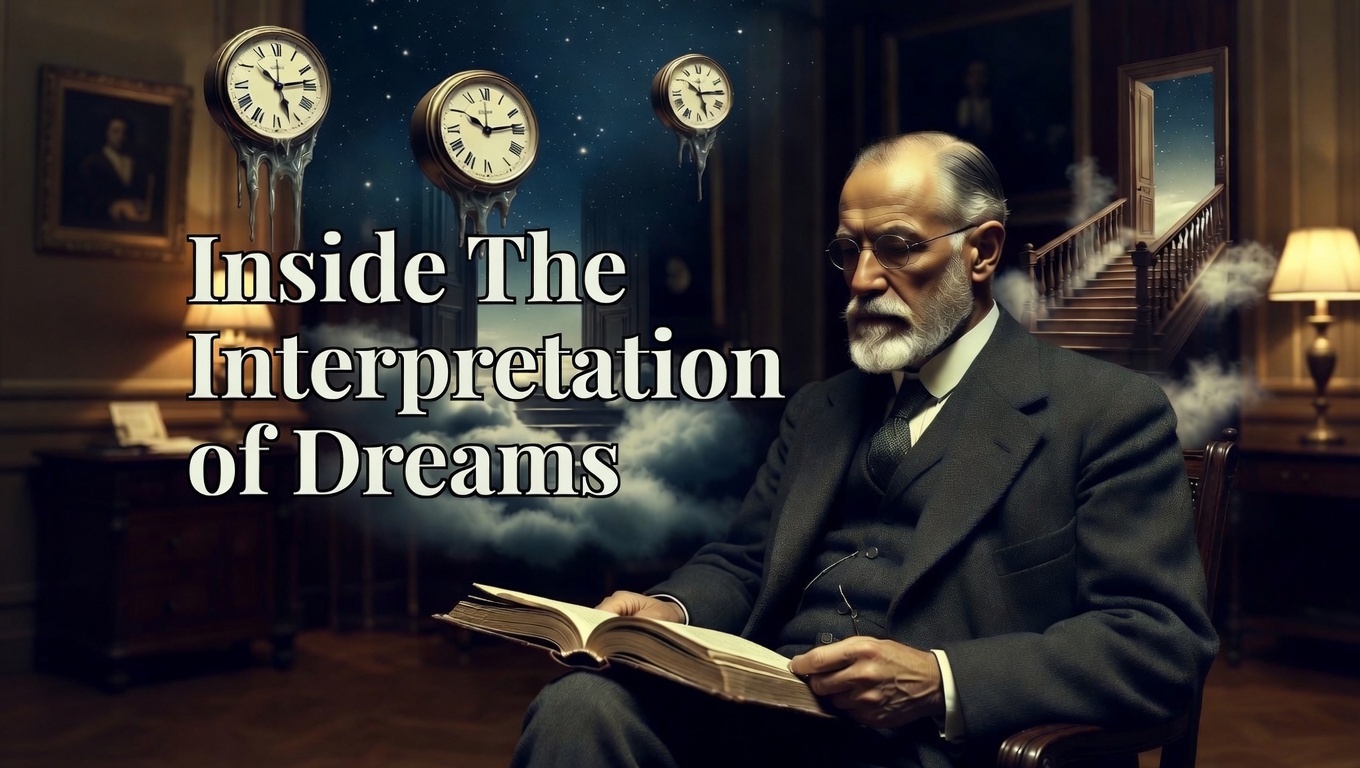
Freud would tell you that dreams are not random. They’re not chaos. They’re not the brain firing off leftover static from the day. He believed dreams were the royal road to the unconscious — the place where the truth speaks, but only in disguise.
And if you listen closely, you can hear the mind negotiating with itself. Freud saw the psyche as a kind of internal government. The unconscious wants something. The ego wants to keep the peace. And the dream becomes the compromise — a coded message passed between two parts of you that rarely speak openly.
He would say that every dream begins with a wish. Not always a pleasant one. Not always a conscious one. But a desire that didn’t get its moment in daylight. So it slips into the night wearing a mask.
And that mask is what Freud called the dream‑work — the machinery that bends, twists, hides, and reshapes the raw material of your inner world. Condensation: where many ideas collapse into one symbol. Displacement: where the important thing hides behind something unimportant. Symbolism: where the mind speaks in images instead of words. Secondary revision: where the ego rewrites the dream into a story you can tolerate.
Freud believed this machinery wasn’t trying to confuse you. It was trying to protect you. Because the unconscious doesn’t care about your comfort. It cares about truth. And the ego doesn’t care about truth. It cares about stability.
So the dream becomes a negotiation — truth wrapped in metaphor, desire wrapped in distortion, fear wrapped in imagery. This is why dreams feel strange. Not because they’re meaningless, but because the ego is asleep, and the unconscious finally has the room to speak without being interrupted.
Freud would say that the dream is the moment when the guard steps away from the gate. The moment when the deeper self walks out into the open. The moment when the mind stops pretending.
And if you pay attention, you can see the patterns. The people who appear again and again. The places you return to without ever visiting. The fears that shape‑shift but never disappear. The desires that hide behind symbols because you’re not ready to name them.
Freud didn’t think dreams predicted the future. He thought they revealed the architecture of your inner world — the angles, the tensions, the collisions you carry inside you.
He believed the dream was a message from the part of you that remembers everything. The part that never sleeps. The part that watches your life like a silent witness.
And maybe he was right. Because when you wake up from a dream that shakes you, it’s not because it showed you something new. It’s because it showed you something you’ve been avoiding.
Freud would say that dreams are the mind’s attempt to finish a conversation you keep walking away from. A way of saying, “Look. This matters. This is part of you.”
And in that sense, dreams are not illusions. They’re mirrors. Distorted, yes — but still reflecting something real.
Freud believed that if you follow the symbols, if you trace the distortions back to their source, you’ll find the wish at the center. The desire. The fear. The truth. Not the truth you tell others. Not the truth you tell yourself. But the truth that lives underneath all of that — the truth that shapes your choices long before you’re aware of them.
And maybe that’s why dreams feel like messages from another world. Because they are. They’re messages from the world inside you.
Freud would say that the dream is the bridge between the conscious and the unconscious — the place where the two halves of the self meet in the dark and try to understand each other.
And if you listen, if you pay attention, if you stop dismissing the strange logic of the night, you might start to see the geometry of your own mind. The loops you repeat. The collisions you create. The desires you bury. The fears you carry. The stories you tell yourself without ever speaking them out loud.
Dreams don’t lie. They just speak a different language. And maybe that’s the real message of Freud’s Interpretation of Dreams: that the mind is always talking to you — you just have to learn how to hear it.

Continue the theory
A new layer opens here soon.