IF:
The Blueprint for a Life That Can’t Be Broken
A study in resilience, identity, and the inner architecture of strength.
There are poems you read… and then there are poems that read you. Rudyard Kipling’s If— is one of those strange pieces of writing that doesn’t behave like literature. It behaves like a checklist. A blueprint. A quiet contract between who you are and who you could be.
Most people treat it like a motivational poster. But if you look closely — really closely — you start to see the hidden architecture. You start to see that every line is a test, and every test is a doorway, and every doorway leads to a version of you that is harder to break, harder to shake, and harder to pull off center.
This poem isn’t about being perfect. It’s about becoming unstealable.
It starts with the smallest challenge: Can you keep your head when the world around you is losing theirs? Not because you’re better — but because you’ve learned to breathe in the middle of chaos. Because you’ve learned that panic is contagious, but so is calm.
Then it asks: Can you trust yourself when others doubt you… without resenting them for doubting? That’s not confidence. That’s internal gravity. That’s the moment you stop outsourcing your identity to the opinions of people who don’t have to live your life.
Every line in this poem is like that — a paradox disguised as advice. It tells you to dream, but not be ruled by dreams. To think, but not be trapped in your own thoughts. To meet Triumph and Disaster and treat them both like temporary guests.
It’s teaching you emotional aikido. It’s teaching you how to stay centered while the world tries to pull you in every direction at once.
And then comes the hardest test — the one nobody passes on the first try: Can you let people count on you… but not too much? That’s the line that breaks most people. Because it forces you to build boundaries without building walls. It forces you to care without collapsing. It forces you to be present without being consumed.
This poem is not telling you how to be a saint. It’s telling you how to be whole.
And if you keep going — if you keep checking off these impossible little boxes — something strange happens. The world starts to open. Not magically. Not instantly. But gradually, like a door that’s been stuck for years finally giving way.
You start to notice that the storms don’t hit you the same way. You start to notice that the opinions of strangers don’t land as hard. You start to notice that the things that used to break you now barely leave a scratch.
Because the poem isn’t about becoming strong. It’s about becoming aligned. Aligned with your values. Aligned with your center. Aligned with the version of you that doesn’t flinch when life throws its worst.
And when you reach the end — when you’ve lived through enough of these tests to understand them instead of just reading them — the poem gives you its final reward: You inherit yourself. Not the version shaped by fear. Not the version shaped by other people’s expectations. Not the version shaped by survival. But the version shaped by choice.
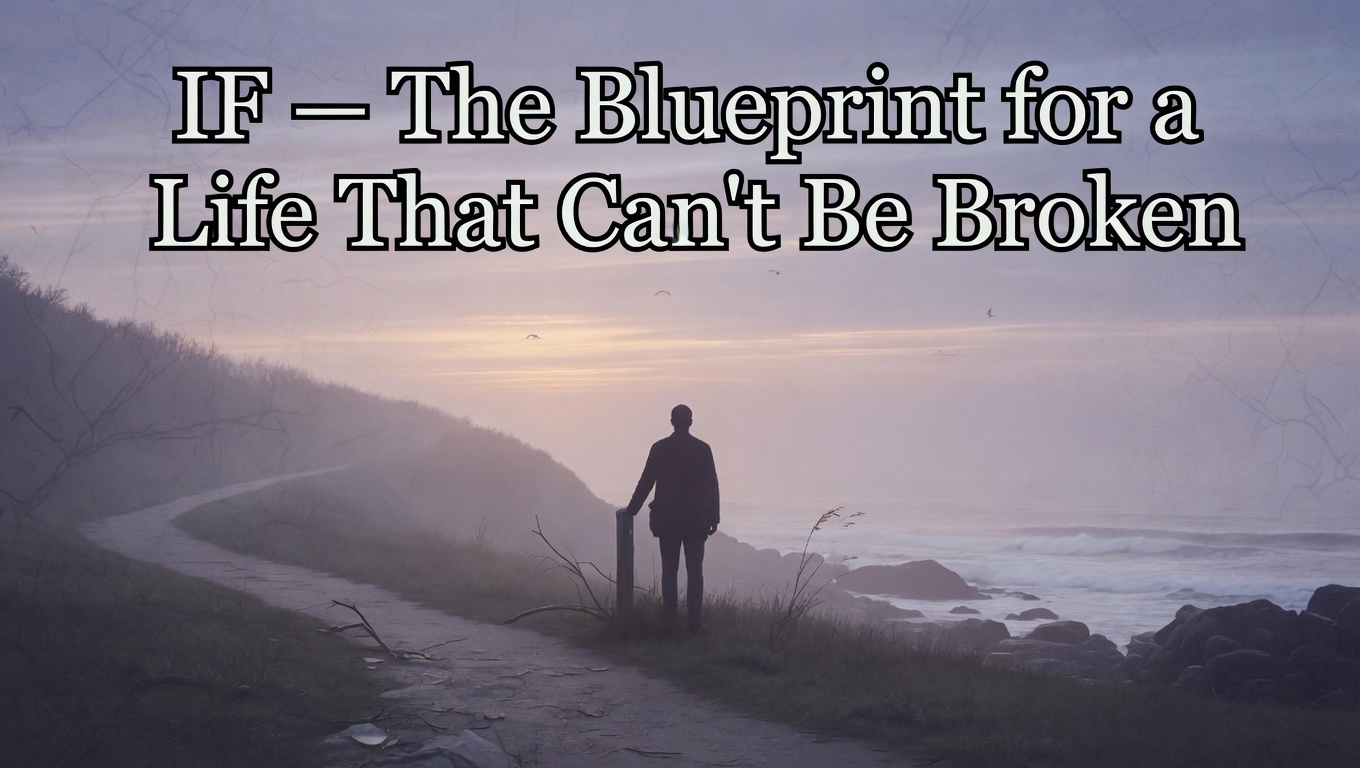
That’s the real meaning of If—. Not perfection. Not stoicism. Not moral superiority. It’s the moment you realize that life isn’t asking you to be extraordinary. It’s asking you to be steady. Steady enough to hold your center. Steady enough to rebuild after loss. Steady enough to keep walking when the path disappears into the fog.
And when you can do that — when you can check off enough of these impossible little boxes — the universe doesn’t reward you with riches or fame or applause. It rewards you with something far rarer: A life that feels like it finally belongs to you.
This is If—. Not a poem. A threshold. A quiet initiation into the version of yourself you always suspected was waiting on the other side.
Continue the theory
A new layer opens here soon.