
Homer’s Iliad:
When History Becomes Myth
A world where memory blurs into legend, and the past survives only through the stories strong enough to endure.
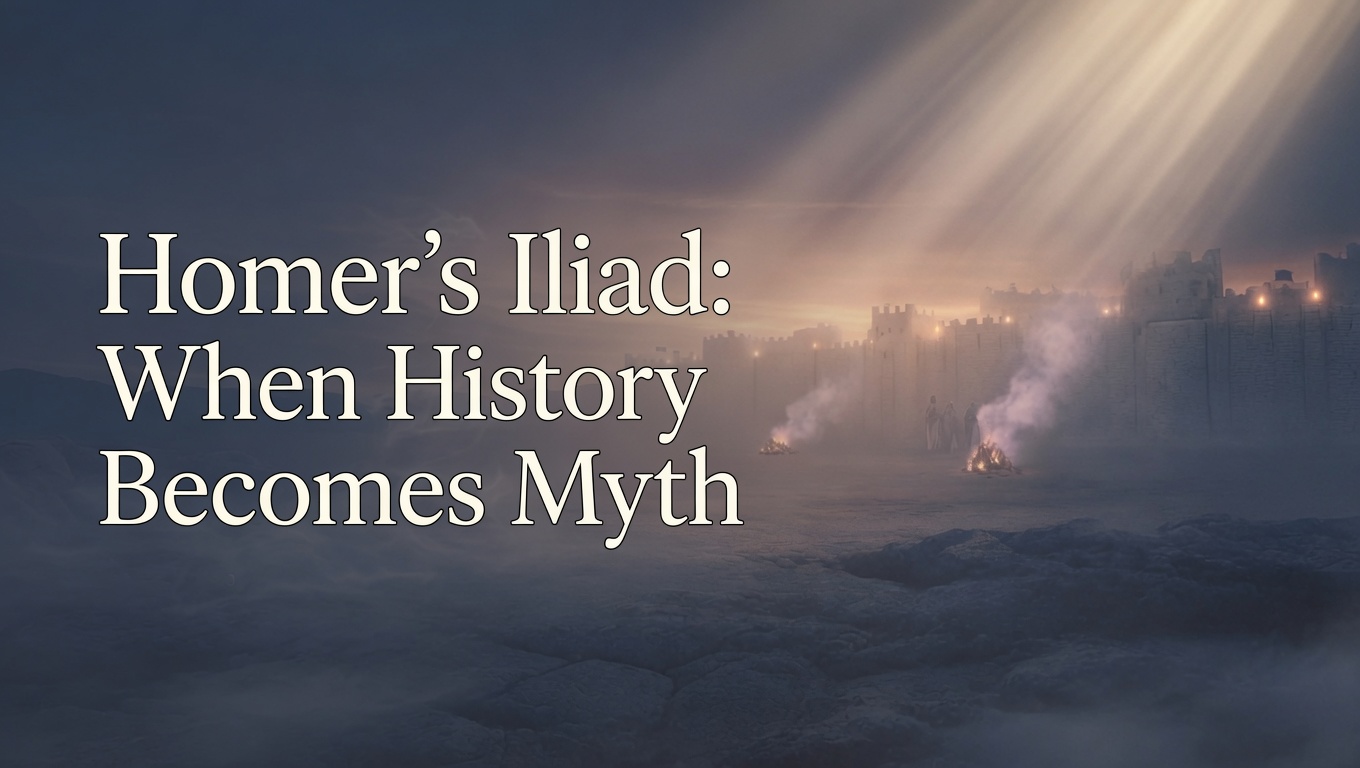
There is a moment in every civilization when memory begins to blur. When the facts of a war, a king, a city, or a single terrible night start slipping out of the hands of the living and into the long echo chamber of time. That is where the Iliad lives — not as a book, but as a survivor of a world that no longer exists.
The Iliad is not fantasy. It is the fossil of a memory. A story carried across centuries by voices, not pages. A war retold so many times that the edges softened, the heroes grew taller, and the gods stepped into the empty spaces where details had been lost.
This is what happens when history becomes myth. Not because people lie, but because people remember in the only way they can — through story, symbol, exaggeration, and emotion. The truth becomes a shape, not a record. A feeling, not a timeline.
And the Iliad is the perfect example. A real conflict, fought by real people, slowly transformed into a cosmic drama as it passed from village to village, from singer to singer, from generation to generation. Each retelling preserved the core while reshaping the surface. Each voice added something, removed something, or misunderstood something. And over time, the war became a legend, and the legend became a myth, and the myth became a foundation stone for an entire civilization.
But here is the part we rarely admit: we are doing the same thing right now.
Our world — our wars, our leaders, our disasters, our triumphs — will not survive in perfect detail. Our archives will decay. Our servers will fail. Our languages will shift. And one day, far beyond our horizon, someone will find fragments of us and try to make sense of what we were.
They will misunderstand. They will exaggerate. They will fill in the gaps with imagination. And slowly, inevitably, we will become myth.
A myth of a powerful age. A myth of a fallen world. A myth of strange machines, bright screens, and a civilization that rose too fast and burned too brightly.
Just like we look back at the Bronze Age and see gods where there were kings, and monsters where there were metaphors, future generations will look back at us and see something larger than life.
This is the loop. History becomes story. Story becomes legend. Legend becomes myth. And myth becomes the only version that survives.
The Iliad is not just a tale of warriors. It is a warning about memory. A reminder that nothing stays factual forever. A reminder that every civilization is one collapse away from becoming a bedtime story.
And yet — there is beauty in that. Because myth is not a failure of memory. It is a translation. A way for the past to speak when the details have died but the meaning still matters.
Homer didn’t write a fantasy. He preserved a world the only way humans can — through the poetry of survival.
And someday, when our world is dust, someone will do the same for us.
This is the loop. When history becomes myth. And myth becomes the only truth that remains.
Continue the theory
A new layer opens here soon.