
Isamu Noguchi:
The Art of Form and Human Meaning
Noguchi didn’t sculpt objects — he sculpted relationships, emptiness, and the quiet geometry of being alive.
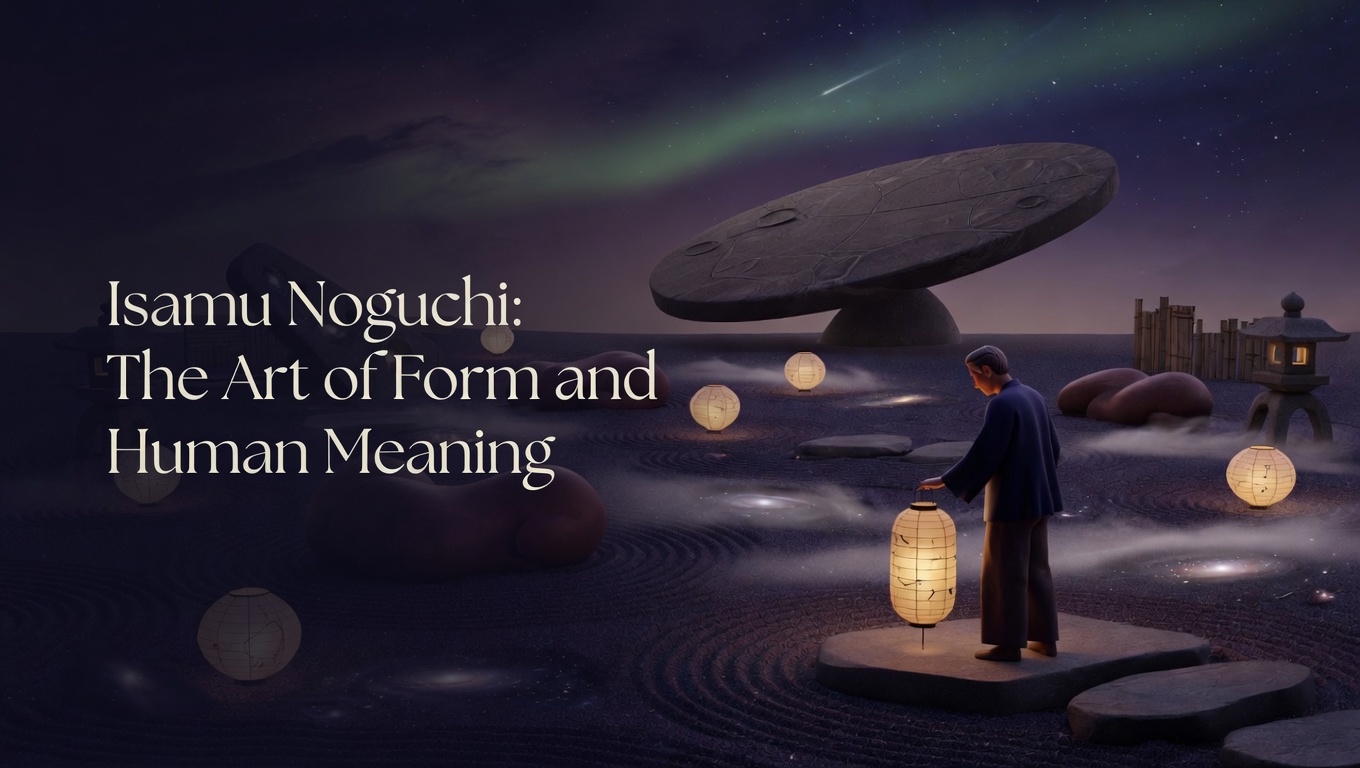
Isamu Noguchi never claimed to be a philosopher. He didn’t write manifestos or argue theories or stand behind podiums. He did something stranger, quieter, and far more dangerous. He tried to understand the world through shape, emptiness, and light — and he believed that if you listened closely enough, the universe would reveal itself in the curve of a stone or the glow of a lantern.
Noguchi didn’t sculpt objects. He sculpted relationships. The way a form leans into the space beside it. The way a shadow completes a shape the same way silence completes a sentence. He believed that everything we are — everything we think, everything we feel — is shaped not only by what exists, but by what doesn’t.
Most people try to fill their lives. Noguchi tried to carve them open. He understood something most of us spend our whole lives avoiding: that emptiness isn’t the absence of meaning — it’s the condition that allows meaning to appear. A lantern only glows because the darkness receives it. A sculpture only breathes because the void around it lets it inhale. And maybe a person is the same way.
Noguchi lived between worlds — Japanese and American, modern and ancient, sculptor and designer, outsider and insider. He learned early that identity isn’t a fixed object. It’s a landscape. A terrain shaped by pressure, time, fracture, and light. He didn’t try to resolve the contradictions. He carved them into his work. He let the tension become the form.
There’s a lesson in that. Most of us try to smooth our edges, hide our fractures, pretend our contradictions aren’t there. Noguchi did the opposite. He treated every fracture as a doorway. Every contradiction as a source of energy. Every uncertainty as a space where something new could grow.
He believed that a life — like a sculpture — is not defined by the material you start with, but by the shapes you’re brave enough to carve out of it. And when he created his Akari lamps — those weightless lanterns made of paper and bamboo — he wasn’t designing objects. He was designing light made gentle. Light that didn’t dominate a room, but invited it to breathe. Light that didn’t shout, but whispered. Light that made space feel alive.
He once said that light is a living thing. Not because it moves, but because it changes what it touches. And maybe that’s the real philosophy buried inside his work: that we are all sculptors of the spaces we inhabit, and the light we carry — or refuse to carry — shapes the world around us.
Noguchi teaches us that form is never final. That identity is never finished. That the self is not a statue, but a conversation between what we choose to reveal and what we choose to leave open. Between the weight we carry and the emptiness we allow. Between the stone and the sky.
He reminds us that the world is not asking us to be perfect. It’s asking us to be in relationship — with our environment, with our contradictions, with our shadows, with our light.
And maybe that’s the quiet truth he spent his life carving into the world: that meaning isn’t found in the object, or the goal, or the achievement. Meaning is found in the space between things. The pause before the next breath. The silence between two thoughts. The curve that only exists because the void allows it.
Noguchi didn’t sculpt answers. He sculpted questions. Questions shaped like stone, shaped like lanterns, shaped like the strange geometry of being alive. And if you stand still long enough — if you let the noise fall away — you can feel what he was trying to tell us: That a life is not defined by what fills it, but by the spaces we leave open for light to enter.
Continue the theory
A new layer opens here soon.