
Lao Tzu’s Tao:
The Ancient Wisdom That Turns Struggle Into Flow
The Tao isn’t mysticism — it’s the physics of alignment, where effort dissolves and clarity begins.
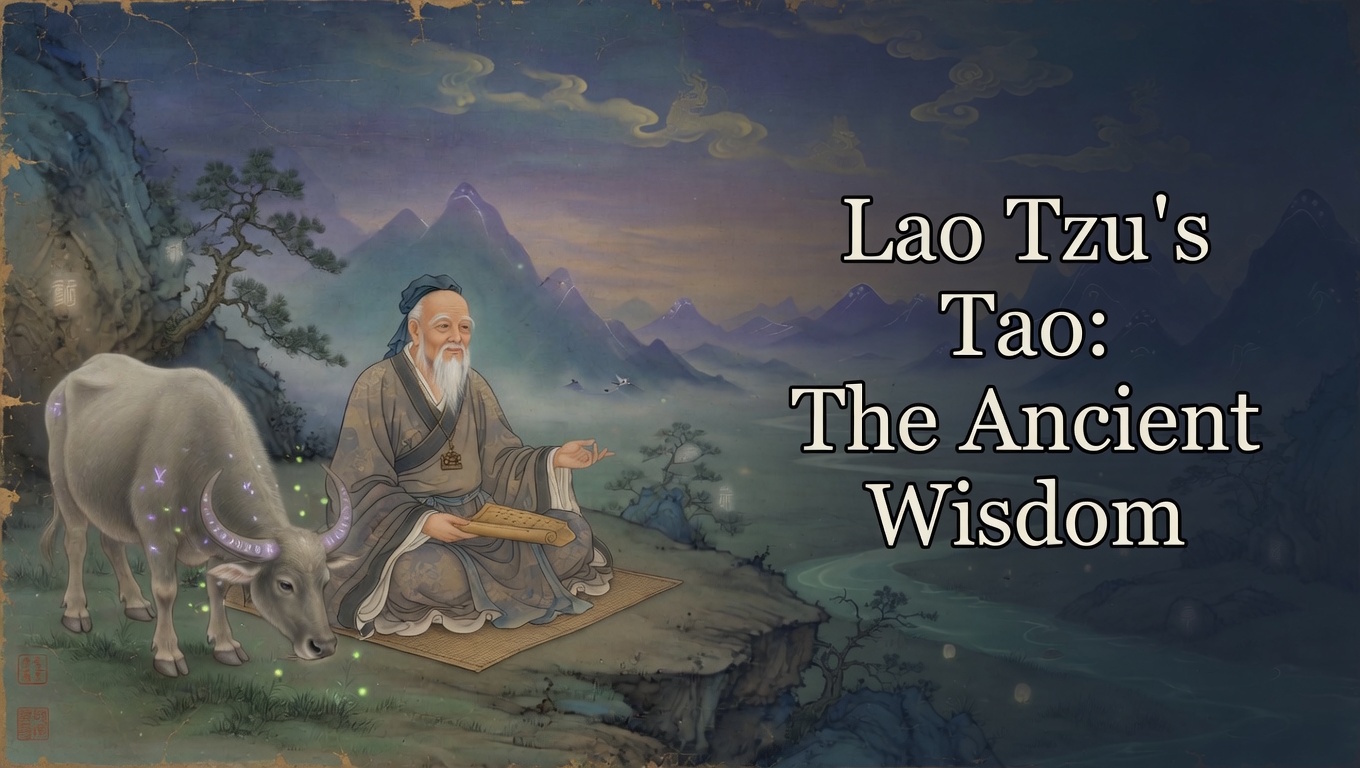
They say Lao Tzu rode west on a water buffalo, leaving the empire behind. No army chased him. No crowd begged him to stay. He just looked at the noise of civilization — the shouting, the arguing, the endless search for control — and decided to walk away.
Before he vanished, the gatekeeper asked him to write down what he knew. He smiled, wrote eighty‑one verses, and disappeared into the mountains. That wasn’t a retirement. That was a system reboot.
The Tao isn’t a religion. It’s a physics of flow. It says: the moment you name the Way, you’ve already distorted it. Every label is a ripple. Every explanation is a shadow. The Way doesn’t need belief — it needs alignment. It’s not something you follow; it’s something you stop resisting.
The Tao begins where ambition ends. It’s the art of doing without forcing. The paradox is simple: the more you try to control the world, the less control you have. The more you let go, the more the world starts to move with you. That’s not mysticism — that’s feedback. The universe doesn’t reward effort; it rewards harmony.
Water is the Tao’s favorite metaphor. It doesn’t fight the rock; it shapes it. It moves around resistance until resistance becomes sculpture. Softness beats force. Yielding wins over control. In TheoryLoop terms — water is the original adaptive system. It doesn’t plan. It doesn’t predict. It just responds perfectly.
Lao Tzu looked at kings and generals and saw people trying to dominate the flow. He realized power isn’t domination — it’s gravitational influence. The strongest leader is invisible. The moment you need to prove control, you’ve already lost it. The Tao doesn’t conquer; it orbits. It bends reality through stillness.
That’s the paradox of power: The more you chase it, the weaker you become. The more you embody it, the less you need to show it. Real strength doesn’t announce itself. It just exists, quietly bending everything around it.
The Tao also teaches that simplicity isn’t poverty — it’s precision. When you stop performing, the Way starts revealing. Complexity collapses into clarity. You realize the universe isn’t testing you — it’s mirroring you. Every frustration, every delay, every obstacle is a reflection of your resistance. The world isn’t against you; it’s showing you where you’re pushing too hard.
Lao Tzu’s silence wasn’t withdrawal. It was signal reduction. He understood that truth doesn’t need amplification — it needs quiet. When the noise dies, the pattern appears. When the pattern appears, the Way becomes obvious. And when the Way becomes obvious, effort becomes unnecessary.
The Tao doesn’t ask you to be good. It asks you to be real. To stop pretending you’re separate from the flow that moves everything. To stop trying to fix the river and start learning how to swim.
In the modern world, we confuse motion with progress. We chase productivity, optimization, and control — but the Tao laughs. It says: “You’re paddling upstream in a river that already knows where it’s going.” The Way isn’t about speed. It’s about direction. It’s about trusting that the current knows more than the map.
The Lao Tzu Paradox is this: The moment you stop trying to find the Way, you’re already on it. The moment you stop trying to understand the Tao, you begin to live it. The moment you stop trying to be wise, wisdom starts speaking through you.
The man on the buffalo never came back. But the Way did. Every time someone stops chasing and starts listening, Lao Tzu rides again — not as a prophet, but as a pattern. He’s the whisper behind every moment of surrender. He’s the geometry inside every act of patience. He’s the silence that turns chaos into rhythm.
The Tao isn’t ancient. It’s real‑time physics for consciousness. It’s the operating system underneath every theory, every loop, every pattern. It doesn’t care about belief. It cares about balance. And when you finally stop fighting the current, you realize the river was never trying to drown you — it was trying to carry you home.

Continue the theory
A new layer opens here soon.