
Zeno The Stoic:
The Origins of Stoicism
A return to the original split between Nature and Reason — and the discipline that shaped a philosophy.
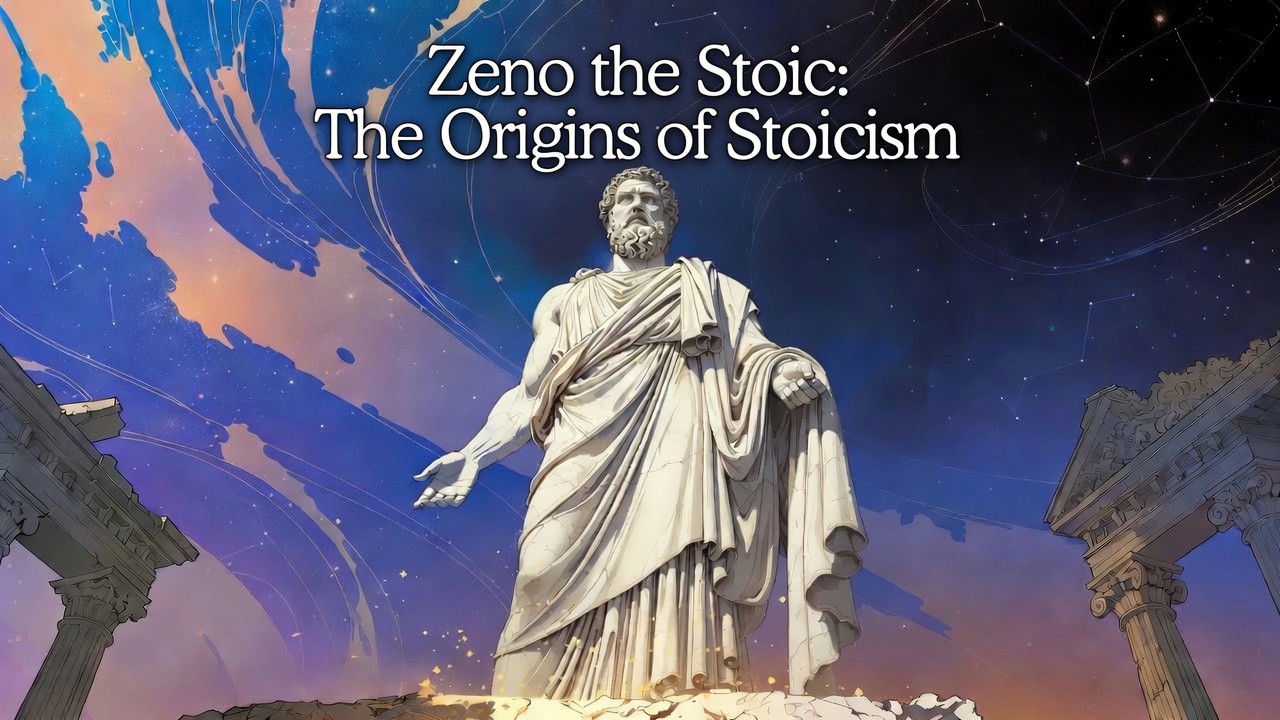
Zeno had a way of looking at life that most people misunderstand. They hear “Stoicism” today and think cold showers, grindset quotes, emotional numbness, lone‑wolf masculinity. But underneath all of that, he was trying to answer one question every human eventually faces: What do you actually control… and what do you only think you control?
He called the uncontrollable part Nature — the unfolding of the world that doesn’t care about your plans, your preferences, or your feelings. And he called your part Reason — not logic in the robotic sense, but the inner discipline that lets you respond to life without being dragged by every emotion that hits you.
Nature is the storm. Reason is the anchor. Nature is the event. Reason is the interpretation. Nature is what happens. Reason is what you choose to do next.
Zeno believed that life is never fully in your hands, but it’s never fully out of your hands either. He said the world is shaped by two forces: the things that happen to you… and the way you meet them.
And that’s where this gets interesting. Because most people live entirely on one side or the other. Some blame everything on Nature — “life is unfair,” “people are the problem,” “the world is against me.” Others pretend everything is Reason — “I control my destiny,” “I don’t need anyone,” “nothing can hurt me.”
But Zeno said the truth sits right in the middle. Life is half what hits you, half how you respond. Half storm, half steering. Half fate, half discipline. And the moment you understand that balance, your entire world shifts.
Nature is the part of life you don’t choose. The weather. The economy. The people who disappoint you. The timing that doesn’t line up. The chaos you didn’t cause. Reason is the part you do choose. Your perspective. Your actions. Your discipline. Your ability to stay steady when everything around you shakes.
Zeno said that when life hits you — and it will — your inner discipline decides whether you break, bend, or transform. And that’s the part people forget. They think Stoicism is about feeling nothing. They think strength is about isolation. They think Zeno was teaching people how to become stone.
But he was teaching something much harder: How to stay human without being ruled by your emotions. He believed the strongest person isn’t the one who avoids pain… but the one who can feel it without losing themselves.
Nature throws you into the storm. Reason is how you plant your feet. Nature knocks you off balance. Reason is how you find your center again. Nature gives you the moment. Reason decides what you make of it.
And here’s the part that feels the most TheoryLoop: Zeno didn’t think you conquer emotion. He thought you learn to ride it. You don’t suppress the feeling. You understand it. You don’t deny the chaos. You stop letting it dictate your life. You don’t pretend you’re invincible. You become steady enough that you don’t need to be.
He believed the world rewards the person who can stay clear when everyone else is spiraling. And that’s the shift. Most people wait for life to calm down. They wait for the perfect moment, the perfect mindset, the perfect conditions. They wait for the storm to pass.
But Zeno said the storm never passes. It only changes shape. So the question becomes: Who are you when the world doesn’t go your way? Do you panic? Do you shut down? Do you blame everything around you? Do you let the chaos decide your life?
Or do you step into the moment with clarity, discipline, and a sense of direction? Because Stoicism isn’t about killing your emotions. It’s about not letting your emotions kill your direction. It’s the discipline to act when others freeze. The clarity to choose when others collapse. The steadiness to move when others wait for the world to fix itself.
Nature is the test. Reason is the answer. And once you understand that, life stops feeling personal. The hits make sense. The timing makes sense. The setbacks make sense. The emotions make sense.
You stop seeing chaos as punishment… and start seeing it as the moment you were built for. Zeno believed the person who thrives is not the one with the calmest life… but the one with the calmest mind.
And that’s the heart of real Stoicism. Life is half what happens to you. Half who you become because of it. And the moment you choose your side of that equation… your entire story changes.
Continue the theory
A new layer opens here soon.