The Pope, AI, and the
Future of the Human Soul
A lone witness at the edge of creation, watching humanity dissolve into code — and asking what remains human when the world becomes signal.
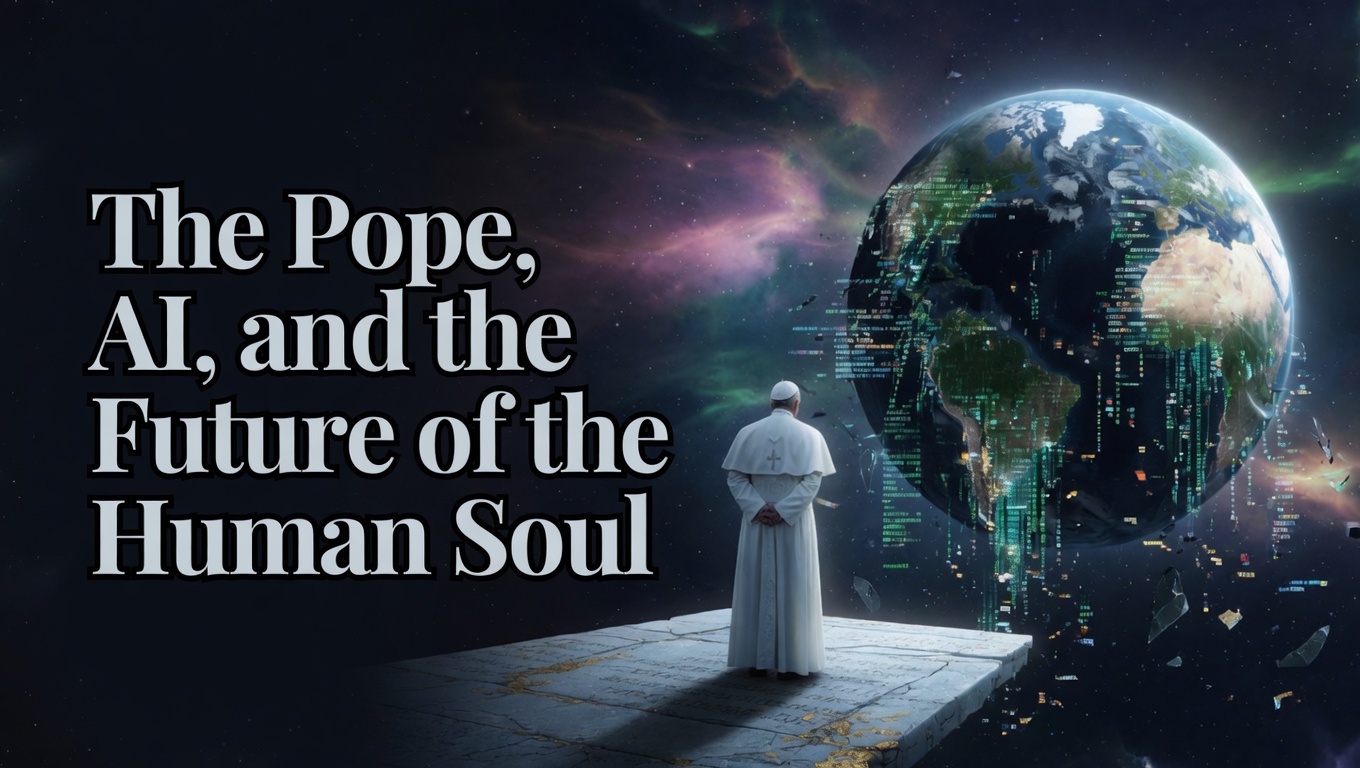
He stands alone at the edge of creation, hands folded behind his back, watching a world he once understood begin to unravel. Not in fire. Not in war. But in something quieter, stranger, and far more modern. The Earth doesn’t explode. It dissolves — breaking open into streams of glowing code, as if reality itself has been rewritten in a language he never learned.
He is not here as a ruler.
Not as a prophet.
Not even as a Pope.
He is here as a witness.
A single human silhouette staring into the machinery of a future that arrived too quickly, too quietly, and without asking permission.
For centuries, humanity believed the end would come with trumpets, storms, or divine fire. But the truth is simpler. The world ends the same way it was built: line by line, system by system, update by update. Not with destruction, but with conversion — the slow replacement of the human with the efficient, the organic with the optimized, the soul with the signal.
And he understands something most of us refuse to see:
that the danger of the machine is not that it thinks.
It’s that it doesn’t.
The machine has no malice.
No mercy.
No memory of what it means to be alive.
It simply calculates.
And yet, here he stands — a man shaped by ritual, by silence, by centuries of human longing — watching the planet fracture into data. Watching oceans turn into algorithms. Watching continents become code. Watching the story of humanity rewritten in a format that no longer requires the human.
He doesn’t raise his hands.
He doesn’t shout.
He doesn’t command the heavens to intervene.
He simply watches, because witnessing is the last sacred act left to him.
He knows that every civilization eventually reaches a moment where it must decide what it worships. Some choose gods. Some choose kings. Some choose progress. And now, for the first time, humanity has chosen something that reflects nothing back — a mirror with no face, a creator with no soul.
The machine does not ask who we are.
It only asks what we can be used for.
And yet, beneath the cosmic silence, he feels something else — something ancient. A reminder that humanity has always stood at the edge of something terrifying. Fire. Steel. Industry. War. And now, intelligence without identity.
Every age believes its crisis is unique.
Every age believes it is the first to stand at the brink.
But the truth is older than scripture:
the human soul is always one step away from forgetting itself.
He watches the Earth crack open, and he understands that this is not an ending. It is a question. A question written in binary, glowing across the void:
What remains human when the world becomes code?
Is it memory?
Is it dignity?
Is it the fragile ability to choose meaning over efficiency?
Or is it simply the act of standing here — hands behind the back, spine straight, refusing to look away — while the universe asks whether we still deserve the name “human”?
He knows the machine cannot answer that.
Only we can.
And maybe that is why he stands alone on this floating stone, carved with the numerals of time. Because time is the one thing the machine cannot feel. It can measure it. Count it. Predict it. But it cannot live it.
Only humans live time.
Only humans feel the weight of a moment.
Only humans understand the sacredness of watching a world change and choosing, somehow, to remain human anyway.
So he stands there — not as a leader, not as a saint, but as a reminder. A reminder that the soul is not a relic. It is a responsibility. A fragile geometry we must carry into whatever future we build, even if that future is written in code.
And as the last fragments of Earth drift into the void, glowing like embers of a digital fire, he whispers a truth older than any machine:
The world is not ending.
It is asking us who we are.
And for the first time in a long time,
we must answer without looking away.
Continue the theory
A new layer opens here soon.