
Michio Kaku:
The Theory of Leaking Gravity
A journey into branes, hidden universes, and the possibility that gravity is bleeding across dimensions into worlds we cannot see.
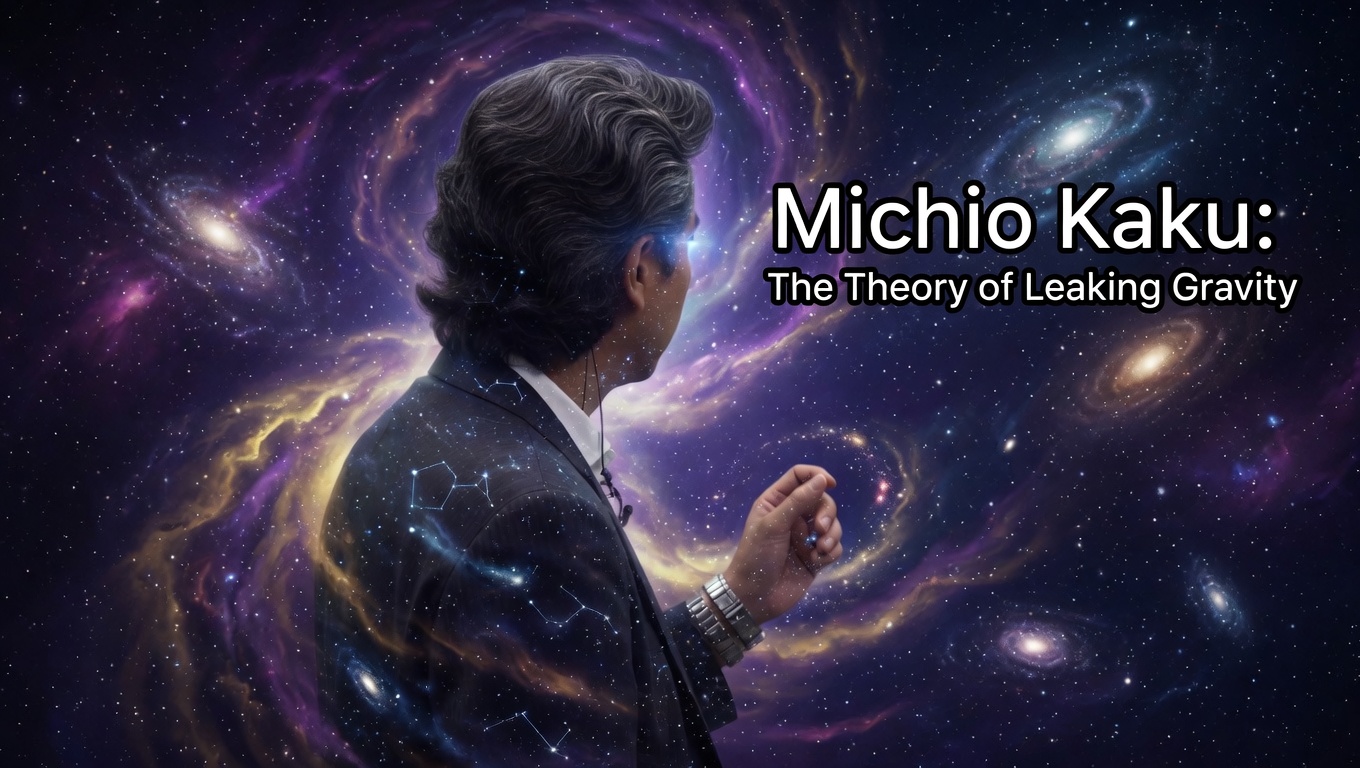
There’s a theory in modern physics that sounds like science fiction until you realize the math behind it is dead serious. Michio Kaku talks about it often — the idea that gravity might not be fully contained inside our universe. That it could be slipping, bleeding, or leaking across dimensional boundaries from a parallel world layered right beside ours.
Not metaphorically.
Mechanically.
In the frameworks of String Theory and M‑theory, our universe isn’t the whole stage. It’s a membrane — a “brane” — floating in a higher‑dimensional space. Imagine a cosmic sheet of paper stacked next to countless others. Each sheet is a universe. Each universe has its own laws, its own matter, its own timeline. And we’re just one of them.
Most forces in physics are trapped inside their own brane. Light, electromagnetism, the particles that make up everything you see — they’re locked into our layer. They can’t escape.
But gravity is different.
Gravity is weak. Strangely weak. So weak that a refrigerator magnet can overpower the gravitational pull of an entire planet. Physicists have been asking why for decades. And one answer is this:
Gravity might be leaking.
If gravity can move through higher dimensions, then the force we feel here is only a fraction of what exists. The rest could be spilling into neighboring universes — or coming from them. And that opens the door to a wild possibility:
What we call “dark matter” — the invisible mass holding galaxies together — might not be in our universe at all. We might be feeling the gravitational pull of matter in a parallel world, bleeding through the dimensional boundary like a faint echo.
Not ghosts.
Not mysticism.
Physics.
A hidden universe exerting real force on ours.
This idea isn’t proven. It’s not consensus. It’s speculative — but it’s elegant. It explains why dark matter is invisible, why it interacts only through gravity, and why the universe behaves like it’s full of mass we can’t detect.
It suggests that our cosmos is not isolated.
Not sealed.
Not alone.
It suggests that the structure of reality is layered, stacked, interconnected — and that the forces shaping our universe might originate in places we cannot see, touch, or measure yet.
And if that’s true, then the greatest mystery in cosmology isn’t a missing particle.
It’s a missing universe.
A parallel world whose gravity reaches across dimensions and leaves fingerprints on our own.
This is the frontier of theoretical physics:
Not just asking what the universe is made of —
but asking how many universes there are,
and how deeply they influence each other.

Continue the theory
A new layer opens here soon.